Institute of Arts
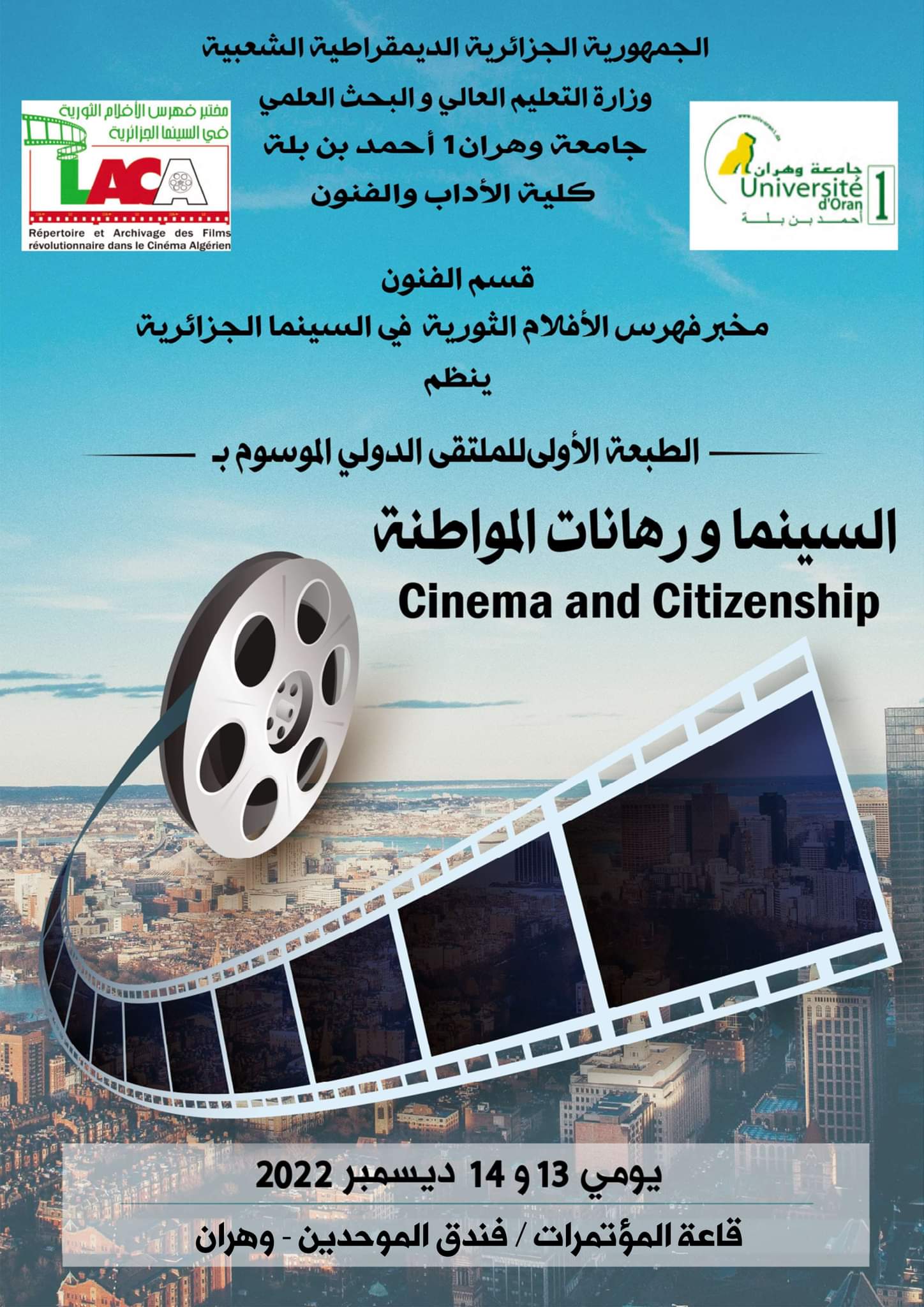
Laboratory of the index of revolutionary films in Algerian cinema
Laboratory Director: Aissa RASSELMA
WebsiteDescription
Laboratory description :
The laboratory has four research teams. Each team has its own areas of interest. We will attempt to present them briefly in the following paragraphs.
The mission of the first team is to collect and study revolutionary films produced before, during and after the revolution. Their study focuses on two main areas. The first focuses on colonial cinema and its role in the genesis of cinema in Algeria in general. The second looks at the most important historical stages that characterise the development of films produced during this period. The aim here is to distinguish between what was narrated by the French themselves, whether they were for or against the colonisation of Algeria, and what was narrated by others. The films produced during the revolution undoubtedly mark the first stage in the emergence of Algerian cinema. This was only possible thanks to René Vautier, who founded the school of cinéma in the Aurès region in 1957, and to the role played by certain mujahideen in describing the colonial reality that led to the outbreak of the Algerian revolution. Among the films produced by this school were ‘Algeria in Flames’ and ‘The Algerian Nation’. The aim of these productions was to internationalise the Algerian question by emphasising the persecution, injustice and deprivation of liberty suffered by the indigenous populations.
The second team's mission is to archive films made during the war of liberation, particularly those produced by the Algerian Film Authority. The members of this team are working to correct the historical facts presented as true by France, which was responsible for the film industry at the time. Revolutionary cinema aims to give as accurate an account as possible of the events that took place, to present the actors who participated in them and to preserve the memory of the facts: these are the key points that motivate the reflection and work envisaged by this team. History is renewed through images with a perspective that makes it more complete, and cinema develops thanks to its rewriting of history; these are two consubstantial realities. The task of the researchers in this team is therefore to make audible what was not audible, what was deliberately kept silent.
There can be no question of efficient archiving, factual restitution and cinematic rewriting of the history of the Algerian revolution if this prerequisite is not met. Aware that many audio and visual documents on the Algerian Revolution remain to be discovered and analysed, the research team has set itself the final task of contacting audiovisual archive centres around the world to build up a collection of films on Black Africa.
The third research team focuses on colonial cinema. Like theatre, literature and songs produced during the imperial and colonial conquests of the 19th century, cinema is the vehicle for a specific ideological discourse. This is why all film productions dating back to this period must be understood as such. In addition to being an expression of a socio-historical reality reflecting the injustice and slavery of an entire people, colonial films also bear witness to the daily life of French colonists in Algeria. The laboratory's interest in colonial cinema responds to certain needs. Given the shared history of the two countries and the 132 years of occupation, it was imperative to approach this cinema as objectively as possible.
The fourth team is working to catalogue documentaries that provide detailed accounts of the various events of the war of liberation, whether they took place in the mountains, towns, villages, interrogation and torture centres, or elsewhere. One of the group's objectives is to determine whether these documentaries follow a predefined chronological structure that could define the layout of the historical narrative, with the aim of seeing whether there is a correlation between the temporality of events and that of the cinematic narrative. The team is also interested in a corpus of documentaries produced by members of René Vautier's Film School. These documentaries, which were broadcast during the revolution, aimed to highlight the Algerian struggle for independence in order to give it visibility and prestige not only locally but also internationally. Finally, the team investigates the documentaries produced after the revolution, including those provided by the revolutionary filmmakers themselves, who were keen to commemorate their exploits. All of these documentaries are subjected to as exhaustive an analysis as possible, as are some others.
Laboratory Members

djeddi kaddour
رئيس فرقة البحث الأولى

dris leila
رئيس فرقة البحث الثالثة

Rasselma Aissa
رئيس فرقة البحث الثانية

kadasi kheira
رئيس فرقة البحث الرابعة
Photo Gallery